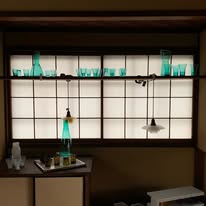
Yusurago is a kissaten in Kyoto opened in 2012 inside a machiya, it turns into a bar at night. Green is the first word that comes to mind, and it is the defining color of this space. The potted plants and a modern noren curtain at the entrance was very inviting so I walked in. I saw a tatami area with a big sofa right by the window, and I immediately felt relaxed. The shop also sells retro Showa-style knick-knacks and features a wall of comic books you can flip through. Everywhere I look, from the tableware, goods, lamps, the matcha shaved ice I ordered... even the speakers and the owner’s hair are all green! The speakers were playing jazz piano. I remembered there was a time in my life when I was obsessed with the color green, I think I bought five or six green sweaters that winter alone. It also reminded me of the artist Elizabeth Sweetheart, known as the “Green Lady of Brooklyn,” who decorates her home and dresses exclusively in green. Apparently, the owner’s wife loves green, which is why the whole shop is filled with it. Green is such a magical and lovable color. Every time I go hiking in the mountains, I find myself surrounded by countless shades of green. As human beings living on Mother Earth, wanting to be close to green feels like a natural thing, at least, that’s how I see it. #yusurago #喫茶ゆすらご #kyotocafe #ゆすらご #京都喫茶店
查看內容 ↗近期內容
🚭No Trunks is a live music and dining bar opened in 2001 in Kunitachi, Tokyo. It was created by the owner, Yataku Murakami-san, who has been passionate about jazz since he was 16. When he was buying his first record, he had to choose between John Coltrane’s Live at the Village Vanguard Again! and a Beatles album. He picked Coltrane, embarking on a life centered around jazz. If he had chosen The Beatles back then, would his life path be completely different today? He has dedicated himself to cultivating the Japanese jazz scene from working as a record store manager to founding the Tokyo New Jazz Festival, helping Japanese jazz culture continue to thrive. Besides weekend live performances, the bar regularly hosts events like record listening sessions and talk shows. On the night I visited, I joined a guitar album listening session. With no restriction on genre, everyone could bring their favorite guitar albums, choose their favorite tracks, and share them with the group. That night, some brought jazz, some brought soul, while others brought blues and even rock albums. Seeing people share their love for music as a community is one of the most beautiful things to witness and participate in. Murakami-san mentioned that this space isn’t limited to jazz, other types of music are also welcome here. Unlike many jazz bars that use JBL speakers, No Trunks plays music through a pair of classic ALTEC A-7 speakers, giving the sound a theater-like depth. Combined with some delicious dishes like the stir-fried eggs with chives I ordered that evening, filling my mouth with savory taste the moment I took a bite. It looks like the next guitar track is about to start playing... I wonder what kind of song it will be? #notrunks #tokyojazz #tokyojazzbar #東京ジャズ #国立
查看內容 ↗🚭Café Ataraxia is a music café located in Jimbocho, Tokyo. The shop’s name comes from the Greek word “ataraxia,” which means a state of calm undisturbed by the external world. It was chosen by the shop owner, who majored in philosophy during his university years. After retiring in 2022, the owner Katsutoshi Kubota-san opened this shop to fulfill his childhood dream of running a coffee shop in Jimbocho, alongside his strong passion for classical music. The café has truly become the embodiment of his dream like a museum packed with his extensive collections, including classical music records, a rare 1926 Credenza phonograph, and a 1912 Sirena phonograph. You have to take the elevator down to the basement to find the entrance, and when I entered the door, I was struck by the view. While the interior isn’t overly fancy, every corner is packed with cool items: a diverse mix of books, albums, artwork, and antiques. Kubota-san explained that he wanted to create a living archive for his collections. I can tell from the the exotic things he displayed like a Wilson A-300 piano manufactured in 1973, oil paintings by Japanese artist Tadao Tanaka, and a unique horn-type phonograph. He mentioned that phonographs don’t use electricity to amplify sound, so the audio you hear feels more like a physical vibration you can feel in your body. Experiencing these subtle vibrations and feeling the sound waves brought a sense of happiness to my heart. Café Ataraxia also hosts events from time to time, including live performances, talk shows and record listening sessions. Inside this space, I experienced “ataraxia” in real time when I was flipping through books while listening to classical music. I felt a pure happiness that filled my heart completely. #cafeataraxia #かふぇあたらくしあ #東京喫茶店 #東京カフェ #tokyocafe
查看內容 ↗🚬Bar Prestige is a jazz record listening bar in Kyoto. Opened in 1995 by the owner Koji Fujii-san, it has been at its current location for 24 years. Fujii-san is dedicated to making this place a ”sophisticated hideaway for adults,“ and I think the interior matches my idea of what a private bar for mature grown-ups look like: clean minimalist design, nicely dressed bartender, large glass windows, neatly arranged bottles behind the bar, soft lighting, and smoking-friendly. A place like this always makes me feel so comfortable. Because it’s located on the 4th floor with large glass windows, the night view outside is stunning. Sitting at the counter seat, I could still see the silhouette of the Higashiyama mountains in the distance, even after dark. The shop‘s audio system plays jazz at a slightly loud volume, ranging from standard jazz to Japanese free jazz. There was no menu, so I simply asked the owner for my usual plum wine and enjoyed my solo time. After the pandemic, the Shimokoricho area of Kyoto has seen an unprecedented influx of tourists, making it packed with people all day long. For me, this is the perfect place to escape all the noise as it offers a rare kind of bliss. With just six counter seats, this place seperated itself from the overwhelming crowds and allow customers to dive into the world of jazz. I am so glad Bar Prestige exists. #barprestige #バープレステージ #kyotobar #jazzbar #京都バー
查看內容 ↗🚬Kissa Takeya is run by the 79-year-old master, Takao Kataoka-san. He is a true Yokohama local, and this shop was established in 1984. The building originally built in 1945 as a post-war inn run by his parents. After the inn closed, Kataoka-san took over the space and fulfilled his dream of opening a cafe that plays soul music. The name ”Takeya“ was actually passed down from the original inn. The walls are covered in nostalgic, faded 80s live concert posters and flyers, and there is a beautifully maintained jukebox sitting right by the tables. Reminiscing about his youth, Kataoka-san said, ”For the first song, I‘d choose a song I was good at to impress the girl I liked with my dancing skills. For the second song, I’d choose one that I could dance to with her.“ The antique-style chairs are very comfortable, and the tables, while old, still have an elegant feel. The shop is filled with the scent of smoke from years of cigarette smoke and the cooking fumes of making Neapolitan spaghetti, the walls have taken on a unique sheen, covering everything into a deep brown color. There is no menu here. Since I arrived a bit late that day, Kataoka-san simply asked if I wanted coffee or tea. I only found out later by checking online that they serve only Napolitan pasta, coffee, and tea! Kissa Takeya has lots of supporters in Yokohama, the very birthplace of Japanese Napolitan pasta. Chatting with Kataoka-san across the counter is definitely the highlight of the cafe experience. You get to hear stories of Yokohama‘s history that you’d never find in a guidebook. He used to have his beloved cats, Momo and Nacchan in the shop, but it seems they have both passed away. After being open for 40 years long, this shop has become Kataoka-san’s pride and joy. He mentioned that he plans to retire next year when he turns 80. Hearing this, I wonder about the wistful feeling that must be settling in for Kataoka-san, and for everyone who love this place... #喫茶takeya #喫茶タケヤ #yokohamakissa #kissatakeya #横浜喫茶店
查看內容 ↗🚬Black Harlem is a soul music bar located in Naha, Okinawa opened in 1990. They usually play ‘70s soul music alongside R&B, rap, and funk from major labels to indie artists. As one of the few soul music bars along Naha’s main street, it was founded by the owner Onaga-san when he was 22 years old, together with his two brothers. The audio system inside was inherited from their father, who designed it himself. Onaga-san mentioned that his father even built a 200 kg platform at home for the turntable to prevent vibrations from reaching the needle because he was someone obsessed with and dedicated to music and sound systems. That same attitude seems to be passed down into the bar. Calling this place a ”soul museum-like soul bar“ on their official website is not an exaggeration at all. They hold a massive collection of rare vinyl records, with the music played at a high volume so all soul music lovers can enjoy it. Onaga-san later traveled to the U.S. to purchase more albums and collect posters and lithographs, which are now displayed on the walls. The deep blue lighting casts a mystical and fantastical feel over the whole space that made me forgot I was in Okinawa and I started drifting in a sea of soul music... Due to its history, many people in Okinawa grew up under strong American cultural influence, exposed to music from the U.S. from a young age. Because of this, I feel the music scene here has many unique aspects that set it apart from the Japanese mainland. With Onaga-san‘s permission to take photos of the interior, I took some shots of the massive speakers and the walls lined with 10000 records. Looking back now, I can almost feel that blue glow surrounding me again, taking me right back to Black Harlem... #ブラックハーレム #沖縄バー #soulmusicbar #okinawabar #vinylmusicbar
查看內容 ↗